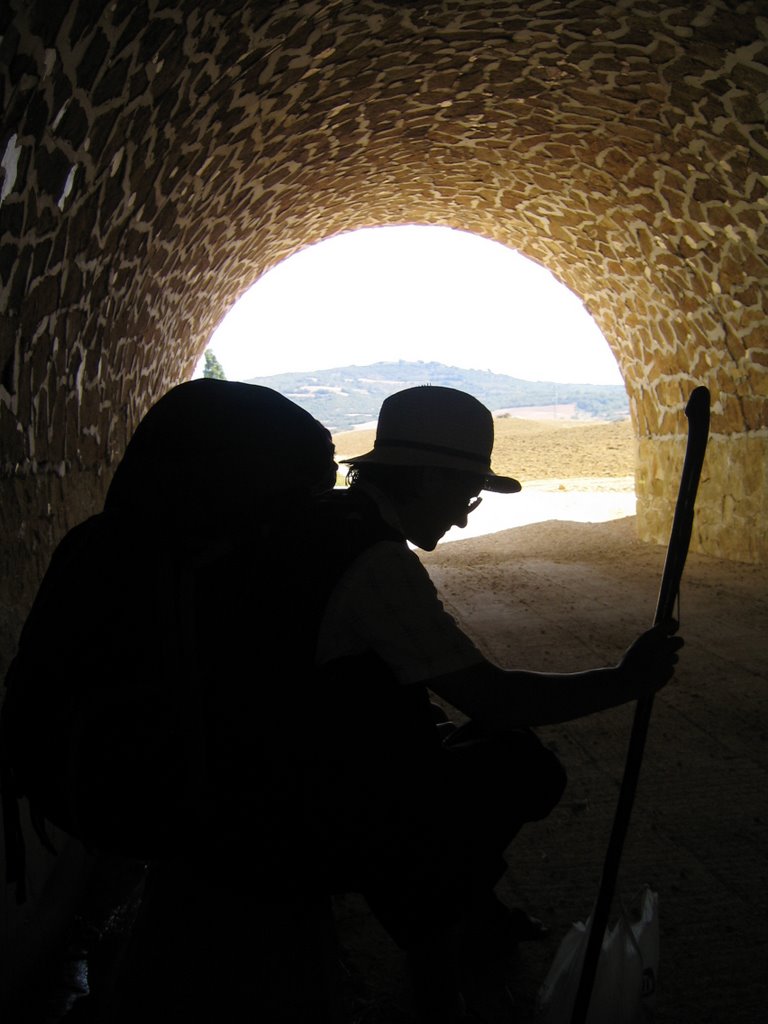
Thursday, December 07, 2006

Bogota - The Journey Begins...

I´m in South America. Colombia to be exact. I´ve been here for just over two weeks now, and as with all travelling experiences the way has been long, windy and unpredictable - full of colourful personalities, mosquitos and bad Spanish. I am now in Cartagena: infamous port town, historical site of gold exportation, pirates and dense, chewable humidity. I will do my best to bring the last few weeks to the electronic page with alacrity, picarseque prose and succinct description. Once again, if you find all this dull and tiresome, just tell me where to shove it.

It all began in Bogota...

Boarding the Paris-Bogota flight, I experienced instant culture shock. Everyone on board was Colombian. Mustachioed, latino faces greeted me everywhere: bored, laconic and exotic. I spent my ten-hour flight engrossed in broken Spanish with the Colombian girls who irritably shifted over, having occupied my aisle seat. After discovering that I was English (and probably having never met an English person before), one of them insisted on helping me ´practice´ my Spanish for eight solid hours. The welcome byproduct of this intercourse was that the flight shot past like a dream; her name was Andrea, she was returning from a two-month cookery course in Paris and was into death metal (favourite band, Rotting Christ). She was single, and had a seven-year old daughter. In the end she invited me to stay with her if I ever made my way to Cali – a welcome, if slightly suspicious invitation, which I´m still not sure I´ll pursue...

Queuing up at passport control, I trod wearily, checking for any signs of altitude sickness – shortness of breath, light-headedness, uncontrollable hallucinations. Nope. The guy at the passport booth checked my passport without once looking at my face.

Leaving the airport I felt immediate jubilation; the air was clear and clean and the temperature mild, like a warm spring day. I grabbed a ticket from the taxi rank, jumped into a waiting cab and was immediately coasting my way through the city limits towards the Platypus hostel in La Candelaria, where I had a reservation. There were no seat belts in the back - typical latin America. With my head stuck out the open window I watched the approacing city; it reminded me of a strange cross between Navajoa (north-west Mexico) and the grimy-grey concrete nightmare that is Phnom Penh (Cambodia). Incredibly calm, empty streets and relaxed-looking citizens.

Arriving around 4:30pm, the sun was already beginning to sink, and the mountains skirting the city appeared as haunting silhouettes in the late afternoon light. My first impression was that a giant, mischievous child has picked up a fistful of concrete and thrown it haphazardly at this high-altitude plateau, causing the earth to ripple and rise up around it. As the taxi coasted through the centre of town I was surprised by how ugly and industrial it seemed; as we approached La Candelaria more young people appeared on the narrow streets, but the sparse, quiet atmosphere didn´t change.

Ugly, eastern-European buildings pollute the skyline with mono-syllabic rows of windows, set against the dramatic backdrop of Cerro de Monseratte. As I arrived, the low-lying clouds transformed the mountain into a squat, vaguely threatening goliath that presided over La Candelaria like a disapproving stepfather.

I got out of the cab a minute´s walk down the street from the Platypus and by the time I reached the door with backpack and bag I was out of breath – my first symptom of the 8,600ft altitude. Over the following days I became more familiar with these sly and subtle effects: walking up a gradual slope brings on mild dizziness and lack of breath, and colours seem more vibrant – though that may just be Colombia in general.

I was immediately impressed with the Platypus – free coffee, and friendly German owner Germann (pronounced Herman) who offered me a free beer before I´d had a chance to drop my backpack. The interior was cool and quiet, with an airlock-style porch arrangement to stop unwelcome intruders. Lovely little courtyard with fountain, backpacks lined up in the corner and a sitting room to the right with wooden tables, a high wood-beamed ceiling and wooden chairs.

My lasting impression of the Platypus is of a rickety firetrap where warmth is emanated only by the people, dedicated staff and free coffee. On my third morning I awoke at 5am from a dream that someone was leaning over me, whispering into my ear, "The air is getting thinner in here, wake up!" I jumped out of bed and vowed to stop drinking so much free coffee.

The only thing that broke the pristine, inner tranquility of my arrival was the sound of English-accented voices, and my first thought – "You go all the way to Bogota and can´t escape the bleeding limeys". Rather than staying in that night and adjusting to the time difference and altitude, I decided to go out with a bunch of mixed geezers from England, Australia, New Zealand and America. The American guy, Adam, had biked his way down from the States to Colombia, mostly overland, and was pushing his way further south. He was an old-skool Tool fan, and I enjoyed berating his lack of long-term dedication later that night while we played drinking games at The Pub in Zona Rose – yet another Irish pub in a totally incongruous setting on the other side of town. This is a totally upmarket zone, full of wealthy, comfortable Colombians who live in a bubble: detached from the rest of the city, and country, at large.

Bogota is a place of strange contradictions, where nouveau-riche brush shoulders with the revoltingly poor and tiny, crippled beggars shine the shoes of tall, well-dressed businessmen as they stare with remote indifference at their watches and well-manicured nails, waiting for their lunchbreaks to end.

La Candelaria, the until-recently poor and dangerous part of town is now and up and coming student zone. The area is mellow, decrepit and full of narrow alleys and old buildings that have become home to youth-friendly cafes, breakfast bars and watering holes (Mora: Mora sells smoothies and looks like an Ozzie joint, and Papyrus plays MPG4 music videos and sells great tequila. We spent a good few nights there whiling away the wee hours). As you traverse the cracked and sinking pavements you can´t miss the vibrant graffiti (none of which bristles with the clan-like anger of London´s tagging), which often references Uribe (the current President), contemporary bands or traditional Colombian people dressed in traditional garb. It is an area that traps travellers and invites poetry.

Damn, this email has become inordinately huge and I haven´t told you anything – about the friends I made (American Chris, Wolfgang the businessman, Emily the writer) or the experiences I had in Bogota. Climbing Cerro de Monseratte for a view that made the city look like an isometric computer game, seeing the clouds dip down and curl over a horizon that looked like the edge of the world and feeling another degree of altitude-induced effects; the Gold museum; the appreciation of new acoustic guitar music; dicussions of Earth Crust Displacement, geology and olde English literature with Chris and Ken; Roçio and Pablo; or the greatest coincidence of all: bumping into a Dutch girl I met fifteen months ago in Barcelona while travelling with my friend Ben.

Her name is Neske. We met in the supermarket after my second filet mignon lunch in two days, giving me the strangest feeling that two distinctly different temporal dimensions had rubbed together like a seismic shift. She´d been travelling constantly ever since we last met, while I´d been back in England, working and thinking about my wanderings in northern Spain. Neither of us could believe the unlikelihood of this coincidence (Bogota to Barcelona?) and I spent that evening at her hostel, watching her accompany English Jack on the violin as he played classic Eric Clapton tracks on a traveller´s guitar.

I could keep going and going and going... I left Bogota with a timid Israeli girl called Debbie and travelled north via beautiful San Gil to Taganga on the Caribbean coast, then walked through the jungle for six days to the lost city of the Tayunas – an ancient Indian culture. I talked to a man who´d spent six years in prison in Bogota for attempted drug trafficking, then opened a seaside Baguette shop with his estranged girlfriend. I read William Burroughs´ Yage Letters, and wondered about Shaun (hostel owner in San Gil) and his own Ayhuasca experiences. And I ate filet mignon for breakfast.

Monday, August 14, 2006

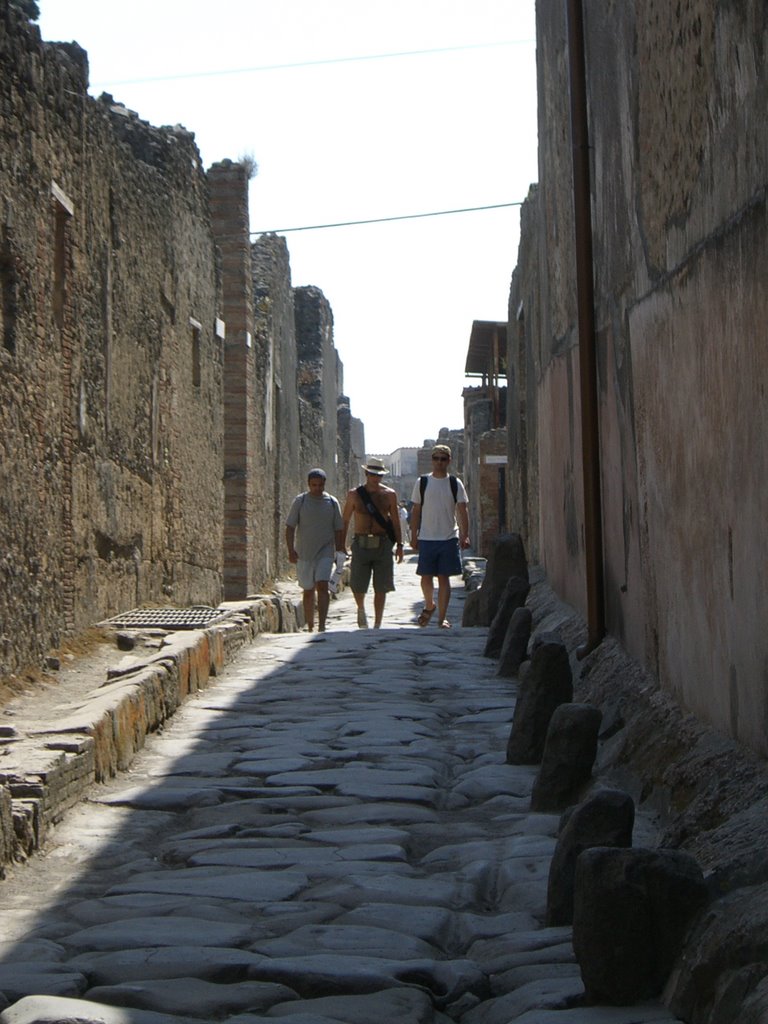
Pompeii, 1942


Pompeii, 1942. A geek-tourist scientist, intrepid explorer and faithful Indian sidekick make good their expedition to discover the lost phallus of Booozsh.

Friday, May 12, 2006

Albert Norman, '05

The rain cascaded down from a template-grey sky. In the distance lightning flashed, illuminating silhouetted buildings. The figure in the garden stood motionless, seemingly oblivious to the torrential rain, arms outstretched as if to embrace the falling sky. On closer inspection one could see that he was naked. Hair plastered over his face, he grinned with closed eyes as the droplets buffeted his face and drenched him from head to toe. Water rose and arched around him as the wind punctuated the rain with a steady rhythm. Lightning flashed again, and the figure turned his back on the city and walked back inside. Albert was his name, and he had tasted the naked world.

Albert sat at the table, elbows propped on the surface in front of him, hands together, fingertips touching. The steeple effect pleased him. He often sat in this position, spending up to an hour with eyes half closed, feeling the warmth of his fingers and the energy collecting between his cupped hands.
He felt hungry, so he stood and headed for the cupboard. The fridge was empty as usual, but this didn’t bother him - he was used to making do with the basics. Inside the cupboard was an assortment of tins and dried foodstuffs: desiccated banana chips that he’d made himself and chickpeas left in sealed containers full of water.
He wasn’t a vegetarian, he just couldn’t be bothered with the complexities of meat preparation. Vegetables and fruit always tasted right to him, no matter how they were prepared.
Albert took a tin of artichokes and opened it, then carefully pored the contents into a bowl, separating liquid from solid. He drank the liquid from the tin, then tossed it over his shoulder into the special bin he had constructed. It sank a metre into the floor, the boards pulled back to expose the vacant earth beneath. The area below was contained with plywood and lined with tarpaulin; a trapdoor has been constructed to close off the small pit when so desired.
Albert hated rubbish.
He looked at the bowl in front of him, then stabbed an artichoke and lifted it up to eye-level. He paused as he directed the fork toward his mouth, examining the vegetable mass with its flowery perfection and smooth root base.
As a physical entity born of the earth, Albert was compelled, daily, to take it into himself. This gravitational mass of quarks, atoms, molecules and countless other components had formed him from its own chimerical substance. Now, to support his continued existence it was necessary to replace his waning form with the appropriate materials gleaned from the surface of the planet.
He looked at the artificial, processed packaging that his food had come from and then looked at the object on his fork. It was severely lacking. He tossed it into the bin and stood up to leave.

Some time later, Albert was outside digging up potatoes with his bare hands and trying to eat them raw. That didn’t work.
Then he took a boot to the temple from the old boy whose allotment he’d broken into and was wantonly ravaging. The Doc Martin collided with his head, sending sparks and dizzy white flashes across his vision.
“What the fack d’ya thank you’re doing?! Get the hell out of my allotment you crazy jigger!!”
“I just wanted the spud mush! I just wanted a taste of real earthy fruit, baby…” He faded out dismally, lost and confused.

Tuesday, May 09, 2006

The Hub

Around the central Hub the figures dance and toil,
like Puppets bound to an ever-rotating spindle
They do not understand the Hub,
only the strings that twitch their limbs
They are preoccupied with the dance,
and the bright colours that flow
Beneath their feet like ribbons

They mourn but briefly when the strings are cut
And continue their merry dance.

What other choice do they have?
The strings are all but invisible,
and the colours of the hub dazzle
and blind them with their beauty

The beauty distracts them from the twitching figures
whose grip on the hub has been lost
No longer connected to the motion of colours,
they labour perpetually in a half-state
They think they are happy,
but the strong healthy puppets can only pity them

Some are connected by only a few wires;
tangled survivors of the struggle to remain connected
They are worse than the twitching paralytics
Lurching around the hub, their eyes bulge at the scene
The others grow uncomfortable in their presence
Sometimes a lone dancer will take the initiative
and cut the remaining strings,
propelling the deviant into the rapidly expanding pile
Of paralysed, twitching dolls

Occasionally, one of these lone initiators will find their dance increasing in its intensity
Whether voluntary or at the will of the hub,
the dancer spirals through the kaleidoscope of colours
Into the hub itself
united with the source and the light and the dance
The others dance on; caught perpetually between the brilliant light
And twitching dark

Friday, April 28, 2006

Tel Aviv

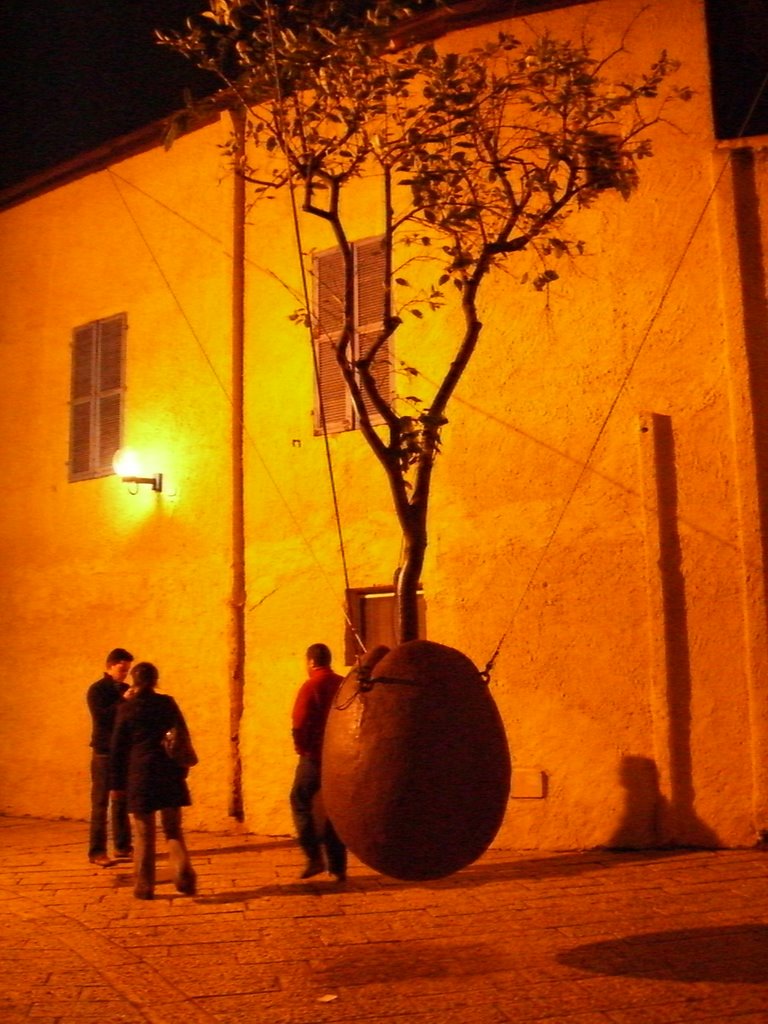
A floating tree in a large seed, located in the old centre of Jaffa in Tel Aviv. Reminds me of a Dali painting. We encountered this on the tail end of a wedding party that beckoned us into their synagogue to join the celebrations, put kippot on our heads and played Klezmer with acoustic guitar that wafted through the air like an alluring scent. Slippery wet alleys and quiet squares in the dark...

Wednesday, September 28, 2005

Los Arcos

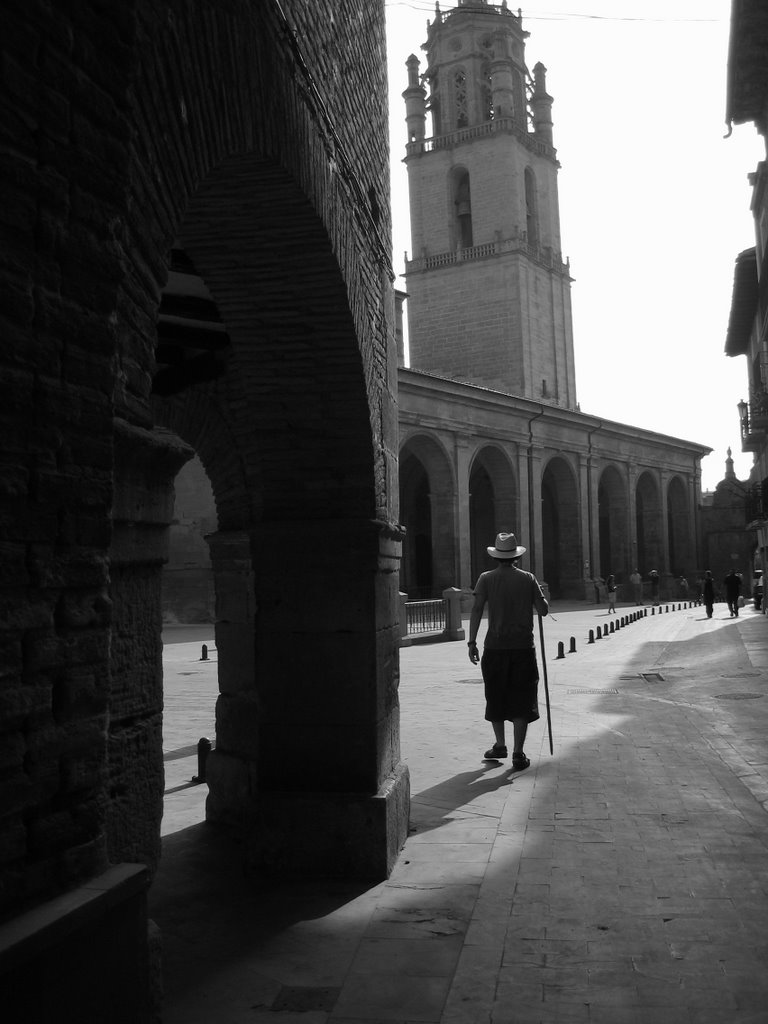
Hot day in Los Arcos, great little town in the middle of Navarrah´s meseta. That´s desert to you and me.

Tuesday, September 27, 2005

Wine fountain


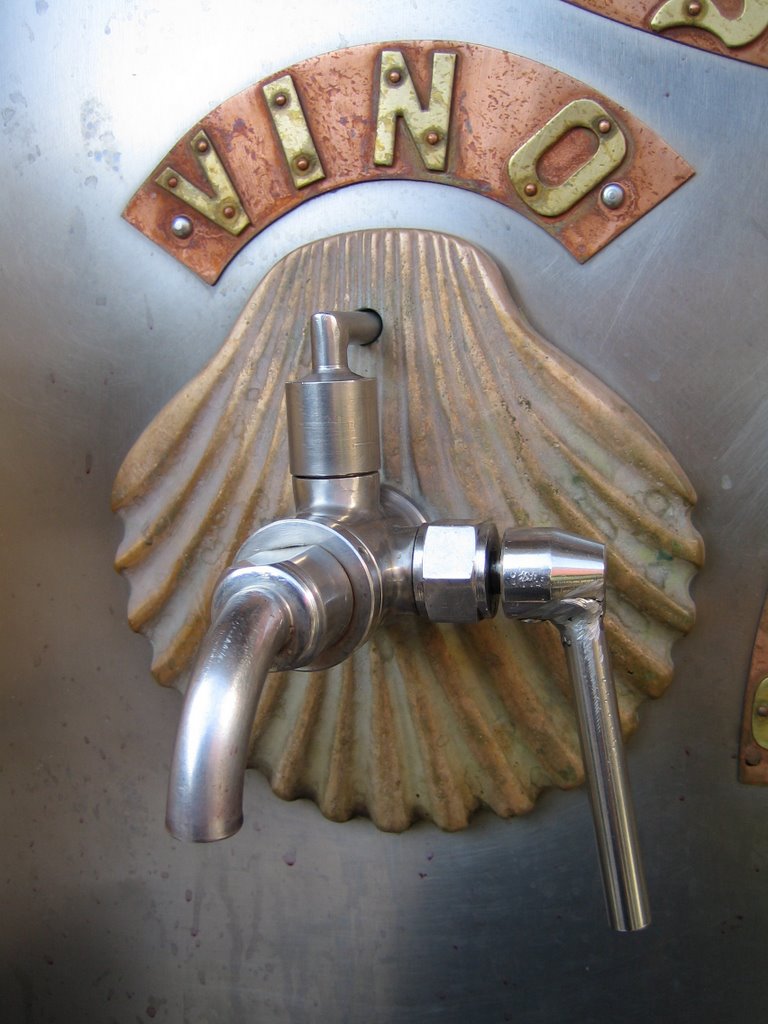
Yes, that's really what it looks like. A stainless-steel, all-you-can-guzzle red wine fountain. Arriving at 8am, I proceeded to swill as much of its frothy produce as my malnourished stomach could handle. Resting on little more than the previous evening's dinner and a few meagre morsels of biscuit, the wine soon worked its magic and I had to fight to stop myself from vomiting, launching into a fast-paced walk that took me quickly away from the brewery enclosure and into the morning glow of the Spanish countryside. By 11am I'd walked off most of the alcohol and still didn't feel hungry. Ah, the metabolic wonder of booze...

Sunday, September 25, 2005

Room to swing a car, Camino '05


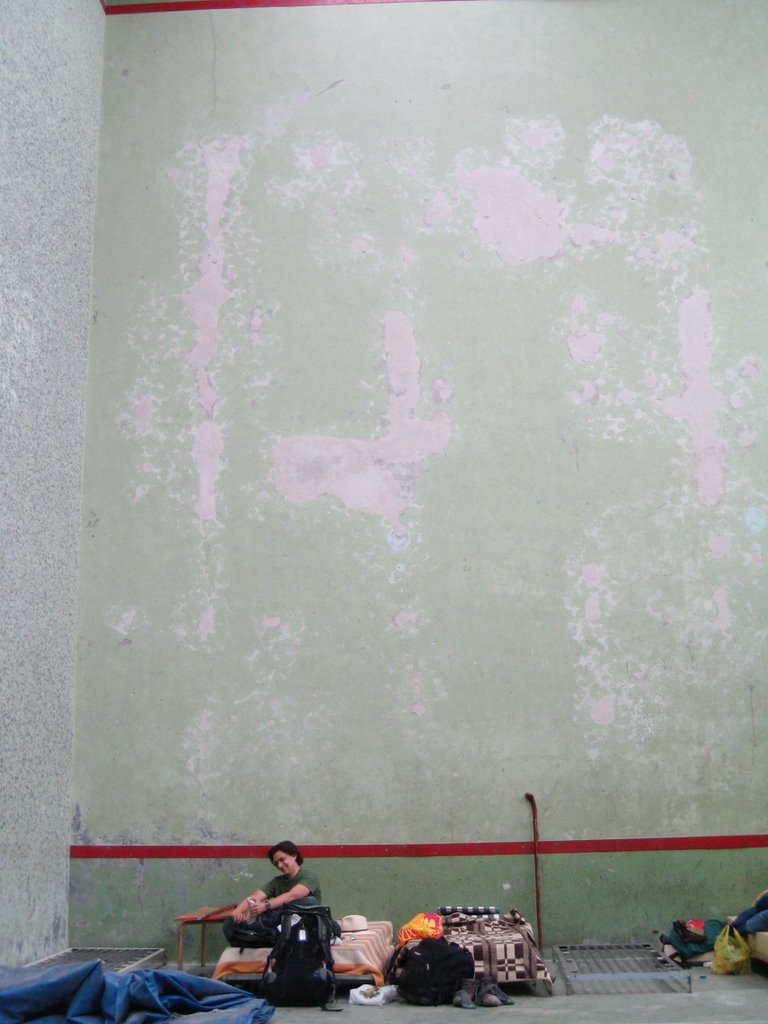
Until you've slept in a half-derelict gym after trekking through 28kms of Spanish forest, you don't know the meaning of fun. Especially when you have a hirsute, didgeridoo-playing German, a cute Swedish teen and a wandering Jew for company.

Thursday, March 24, 2005

Cathars and Spirituality

On 'Good' and 'Evil'

Though the attempt to quantify what is 'good' and what is 'evil' may appear irrelevant in this age of scientific realism - the important and vital qualities of religion having been dumbed down or long forgotten - the issue still holds great importance in understanding the absurd society in which we live. The observant Christian will follow his or her religion beliefs, living by the tenants of a faith which dictates the importance of charity and abstinence, in order to avoid the devil and achieve salvation. Yet, the paradox is glaring - we live in a society based entirely in the certainty of scientific fact, most of which contradicts or ignores the foundations of spiritual faith. Many alternative philosophies, such as Existentialism or Satanism believe that the line between good and evil is non-existent - that the two are interchangeable and part of the same, closed system. The Humanist vision, to which both of the previous world-views can be attributed, is one of an unbiased existence in which man lives according to the whims of his nature, whether they be social/antisocial, destructive/constructive, or other.

Yet the truth, as ever, is in balance and equilibrium. The truth is that evil breeds evil; indulgence breeds ignorance, and success breeds jealousy. It is far harder to indulge in good, because someone will always mistake it for bad. And then the indulgent will grow fat on the work of good men.

The Christian ideal is perhaps the most fascinating remnant of an earlier, more enlightened age. As Roman Catholicism stole its imagery and substance from earlier religions (including Judaism and the many 'Pagan' faiths), it contains a great deal of corrupt truth. If we look at the source of these ideas and the eras from which they arose we can shed a great deal of light on the true meaning and application of these 'truths'. One of the most interesting elements within Catholicism is that of the conflict between 'good' and 'evil', or God and Satan. God is always portrayed as a being of light and 'good', whilst Satan is consistently depicted as a being of darkness and 'evil'. But, as many people are aware, Satan was in fact an angel of light who was cast out of heaven for challenging the word of God, just as Lucifer rebelled in giving fire to man. The two angels are in fact one and the same, representing independent action and freedom of thought, rather than blind deference and obedience - a principal upheld and enforced by the Catholic Church. And why? Because Catholicism is a system designed to safeguard money, power and influence; an institution installed to keep the people lowly and the indulgent in power. A far cry from the original intentions of the Christianity.

The concepts of 'Good' and 'Evil' have existed for thousands of years, it is only in the past two millenium that they have been given such distinct embodiments. Figures representing greed, lust and human desire have been present in countless religious systems including the Greek and Roman Gods, the Norse myths and many lesser-known Pagan entities. One of the most obscure and lesser-known belief systems to focus on the interactions of good and evil is the Christian-derived Cathar religion. Closely connected to the Knights Templar, the Cathars occupied a large area of Southern France known as the Langue d'Oc, living in rural simplicity and practicing a religion that appeared, on a first glance, to bear a strong resemblance to contemporary Christianity. A closer look however, revealed a glaring contradiction: the Cathars believed that Mary Magdalene had been the lover and wife of Christ, and that she had fathered his children. This meant that they viewed Christ as a mortal man. This meant that sex was not an unholy sin. This meant he was no more the 'Son of God' than any other deeply spiritual individual; indeed it suggests that for the Cathars, Christ was a true icon - an example of faith rather than an object of patriarchal salvation.

The Cathars also held a particularly esoteric belief, echoed in the practice of the mystery schools of ancient Egypt and the Middle-East, to which no parallel can be drawn in current monotheism. They believed that within our realm of experience are two distinct spirits: one of the Earth, or the lower plane, and one of the higher spiritual plane. These two spirits are not enemies, nor are they mutually exclusive, they are interdependent and part of a single hierarchical system. The earthbound spirit works in the field of life and serves the ego of need. In turn, this spirit is fuelled by the individuals that worship it. This spirit also represents indulgence and the self - if the individual consistently indulges in the fruits of the material world, operating from a selfish viewpoint alone, then they are indulging in the food of evil and will never move beyond the earthbound spirit into a higher realm. The other, more subtle spirit of the higher plane exists beyond the realm of material pleasure, and will never be reached by those who do not see beyond the material. To reach this spirit we must continue our evolution and move beyond our physical and spiritual preoccupations to reach a higher realm.

Unfortunately, the earthbound spirit represents a far greater attraction because it exists within our own world; in the physical realm that surrounds us, and in everything that we desire. The higher spirit is a far greater challenge; it exists in our dreams, in our love and in moments of ecstasy that cannot be easily repeated, unlike the pleasure of a good apple. This higher spirit exists in a vibration that we can only reach through intense focus, and then only momentarily. It takes great effort to maintain, in contrast to the lower spirit that vibrates within our own range. And so we have a choice: to serve the earthbound spirit or to seek the higher spirit and complete our evolution. However, these two spirits are not distinct, separate entities but part of a bandwidth that stretches way beyond our material consciousness. We are low-vibrating creatures, capable of distraction and preoccupation, and thus prone to enslavement by the enticing earthbound spirit. This is the truth of 'Good' and 'Evil': the more that we serve the spirit of material satisfaction, the greater the evil that we can wreak upon our fellow humans and the world around us. It is time to evolve.

Wednesday, March 23, 2005

Steve Albini Interview


Emerging from the ashes of ‘80s hardcore, Big Black were a post-glacial reaction to corporate rock and an evolutionary step along the punk ladder. From these humble beginnings emerged Steve Albini, the snarling purist whose DIY ethos revolutionised the underground music scene. Outspoken and unapologetic, Albini soon gained notoriety for an unflinchingly hostile attitude towards the media, compounded by a defiant attitude in the face of criticism.

Never afraid to make enemies and always ready to speak his mind, Albini’s seismic blend of jackhammer drumming and buzz-saw guitars lay the groundwork for the ‘90s industrial scene. With over a thousand albums to his name from bands such as PJ Harvey, Bush and Nirvana, Albini stands as one of the most influential, yet anonymous producers in the history of rock. Following a brief sojourn with the controversially named Rapeman, Albini formed the indomitable Shellac: one of the co-curators of 2004's All Tomorrow’s Parties. RC decided to investigate the truth behind rock n’ roll’s maverick.

You studied journalism at college. What made you choose a career in music?

I couldn’t say I was pursuing a career in any sense. The whole time I was in school I was in bands, but to be honest it never really occurred to me that there was a job there. No one had any expectation that these bands would ever make their money, earn them a living; that they would ever be carried through life on punk-rock’s shoulders. However, that’s not the same as saying that it wasn’t important to everybody – it was deadly important.

So what inspired you to actually start making music? Was there any particular band that sparked you off?

The Ramones. I can say with quite a bit of confidence that if I’d never heard the Ramones I wouldn’t be involved in music at any level. I came to Chicago in 1980, and at that point the punk scene was kind of like a secret society. The bands that were around at the time were all perverse and amazing bands: the Effigies, Naked Raygun; really utterly unique bands, and I don’t just mean unique for the day, I mean unique. I can’t think of another band that behaved the way those bands behaved at the time, and in retrospect that’s what I liked about punk-rock, was that each and every band was a completely distinct package of behaviour.

How did Big Black start out?

During my spring break in ‘81 I recorded a couple of songs in my apartment. One of the people I distributed the cassette to was the manager for the band The Effigies. They were running a co-operative record label called Ruthless Records and offered to release the tape as the Lungs EP. The first rehearsals were done with Naked Raygun’s Geoff Pezzati on guitar and me playing bass, and we had a drum machine.
At the time it was kind of a novelty for any band to have a drum machine; they were either treated like very simplistic metronomes or they were used as a sort of imitation drummer, and all that just seemed totally retarded to me. The drum machine is an idiosyncratic instrument that’s got a lot of charisma and personality. Not taking it seriously as an instrument to me just seemed really… cheap.

The harsh guitars and relentless drum loops provided the backbone of Big Black’s sound. Was this a reaction to rock music in general?

Sort of. Everybody in the punk scene thought the mainstream audience were the stupidest people on earth, and we would have been saddened and offended if they had showed up to any of our gigs. Our fights were with the populist, ‘pop’ end of the new wave spectrum which I found really abhorrent. We didn’t really have any fights with Prince or Madonna. You end up getting in fights in your own neighbourhood, y’know? A 12 year-old kid doesn’t get on a bus and go try to assassinate the president, and the reason that he doesn’t is because that’s so far beyond his experience that he’s not even pissed off about it.

Big Black built up a huge cult following but split just before releasing what went on to become your most successful album: Songs about Fucking.

There was a practical reason for that. About a year prior to us breaking up, Santiago decided that he was going to go back to school. We scheduled everything so that it would finish by a certain date and the day after we got home from our final tour, Santiago showed up for his orientation for law school. I didn’t see any value in trying to replace him. Santiago was there from our first public performance, and I felt like he was really important for keeping my latent megalomania in check. We just figured well, that’s it, we did a good job. Big Black accomplished a lot and I was happy and proud of it.

‘Rapeman’ caused some controversy.

Ah screw that, who cares. Nobody cared about that. I mean sure, Rapeman is an ugly name; big deal, fucking get over it. And to my mom it’s no more offensive than ‘Sex Pistols’. The English music press made it seem like it was the most incredible thing in the world that somebody could name a band like that. They were drunk with power and they wanted to make a big deal out of it, whatever. It really broke my heart when we split up ‘cos I really loved playing that music, and I really loved playing with those guys.

You worked on the Pixies’ critically acclaimed debut album. How did that come about?

I was sent a demo that they had been selling around Boston which included their first EP Come on Pilgrim plus about a half dozen other songs, and I thought their music was fine. The number one goal was for them to get a record out of it that they liked, but the problem was that they didn’t express themselves very well in the studio. I enjoyed working on that record, but their music really didn’t make much of a dent on me. I’m not really that selective about who I work with and if it doesn’t seem like there’s a problem then I’m happy to do it.

How did you feel about the prospect of working with Nirvana after the success of Nevermind?

Well, I had been kind of insulated from the whole fracas about Nirvana becoming famous because I didn’t listen to the radio. So none of that stuff really percolated into my attention span, but I was aware of the fact that Nirvana had been part of the underground and then had sort of graduated into the big leagues. Then and now, I still think of bands that aspire to a mainstream level of success as being kind of vain and foolish. However, once I got to work with them I enjoyed their company, I respected them as a band and thought they made a great record.

Did you find yourself under any commercial pressure?

Oh I couldn’t give a shit about commercial pressure, none of that mattered to me. It mattered to all the flotsam and jetsam that were attracted to Nirvana, all the shit-box people that were there; their management people, their record label, their fucking hangers-on of all types. Now after the fact, Geffen’s Gary Gersh went out of his way to try to cause trouble. He was calling journalists and saying, “Yeah, this new Nirvana record is terrible and it’s all Steve Albini’s fault”. So I said, “Well Gary Gersh can go fuck himself.” And that started a big fracas with the record label.

Where any alterations made to the original recording?

Yeah, but I don’t think it had very much to do with that. After they finished the record the band were getting yammered at by everybody telling them how bad the record was and how they shouldn’t release it. It was a little bit uglier, a little bit darker. From the evidence, Kurt’s drug use had kicked back in and there was a lot of personal stuff tied up in the completion of that record.
It doesn’t surprise me that the record ended up changing a little bit, but to my ears it seemed unnecessary. It was like “Well, I’m afraid this won’t kick out of the radio hard enough, I’m afraid that it won’t sound enough like Boston,” or something. I don’t know what the fucking deal was.

What do you see as essential to a band?

I’m really only interested in music that surprises me. And what surprises me most is when I feel like I’m part of a genuine communicative or creative impulse from somebody else. What I like is to feel that the person making the music is being on the level with me; that they’re earnestly indulging a creative impulse, as opposed to just doing it for show.
I’m not really interested in the poetry of the expression. Music is way more than just the notes, y’know? It’s a conversation or it’s a gesture, and if you just repeat a gesture mechanically then it’s not an inspired gesture, it’s just a fucking pantomime. There are some movies that are better if they’re naturalistic, and there are some records that are better if they’re naturalistic.

What has been your most satisfying project to date?

Well, there are personal relationships that are formed from being involved in music that are immensely satisfying. For example there’s the band Silkworm who I’ve been making records with for a long time. We’re great friends, and our friendship wouldn’t have come about if I hadn’t been working on their records, and I think that’s what I take out of this job more than anything else.

In your essay The Problem with Music, (originally written for Chicago journal The Baffler) you detailed the duplicitous nature of the music industry. What advice would you offer to unsigned bands looking to make a career in music?

I wouldn’t presume to tell them what to do because everybody has to make their own mistakes, but they should be conscious of the way that the business operates. The people who’ve survived the longest and made the most durable and admirable careers have remained independent.
If you look at a woman like Annie DiFranco, okay, she’s not on the cover of Rolling Stone, but I guarantee you she makes more money off her records than Avril Lavigne makes off her 10 million. The same can be said of Fugazi and the Dischord record label. By keeping it close to your chest you can make sure nobody else fucks you, but more importantly you can make sure that nobody is fucked on your behalf.
Bands are encouraged to take this unrealistic view that they’re Robin Hood, taking money from this evil company. What the evil company is doing is placing a bet on them, and the bet is that they can make more money out of them, and if that doesn’t work they’ll make sure that the band is destroyed. So if your band means nothing to you, if you don’t care whether you’re paid fairly and you just wanna have this experience of being a rock star, then whatever. You pays your money, you takes your choice. So I don’t really have specific advice, but I have a perspective.

What is the future for Shellac? Are you working on any new material?

Shellac’s my band, and I’m happy to be in this band for the rest of my life. We’ve been recording over the course of the last year, but it takes us a long time to do anything. We spend a long time between sessions.
Watching you perform live, it seems like you guys are just having great fun. Would that apply to your attitude to music in general?
Yeah, I don’t do this for a living, I do it because it’s the most fun that I ever get to have. I can’t imagine why you’d do it otherwise. If you were just doing it to pay the rent, man there’s a lot of easier ways to make a living. And if you’re doing it because you want to be famous, go shoot somebody. You get famous right away that way.

If you would like to read an extended version of this interview, please email me at selbo66@hotmail.com

MS

Saturday, April 27, 2002

El Camino de Santiago, 2002


The Camino 2002 - A Retrospective Journal

I was on my way to Spain. After two and a half hours at Gatwick airport – just enough time to check-in, browse at WHSmith and enjoy a last KFC (damn my greasy addiction) – I was sitting in the window seat of the 12:20 Easyjet flight to Madrid feeling tired, dazed and apprehensive. I hadn’t had much sleep the previous night, and in all honesty I didn’t know what I was doing. At that precise moment, my plans were totally insubstantial; I knew only that I was flying to Madrid to begin a long, indeterminate journey across the North of Spain following an ancient pilgrimage route known as the ‘Camino de Santiago’.
Most people know of the Camino from Paulo Coelho’s The Pilgrimage: an account of his personal ‘experiences’ searching for a sword somewhere on the route to Santiago. My journey had no such aim. I knew only that now was the time for action - walking the Camino was a conscious attempt to abolish laziness and lethargy, and a continuation of my new-found faith in signs and the universal magnetic consciousness.

I stared at my brand-new copy of the Lonely Planet’s Walking in Spain, which contained a short section on the pilgrimage, outlining a 28-day route. It seemed like a remarkably short amount of time to cover 738 kilometres.
A girl with a pleasant and friendly exterior sat down next to me. She had shoulder-length brown hair and distinctive Spanish features - more European than Mediterranean. After we’d taken off and my usual plane-crash anxieties had been quelled, I stared out of the window wondering what the hell I was going to do when I arrived in Madrid. I didn’t know where I was going to start the walk, and my faith was waning slightly; without a scrap of tangible research, I'd brashly told friends and family that I was going to walk the whole route.
“From St. Jean Pied de Port to Santiago de Compostela. That’s 738 kilometres; all the way from the Pyrenees to Galicia on the West Coast of Spain.”
I had a nice colourful map on my wall depicting the route, printed from a website URL I couldn’t remember. But in my heart I had faith that events would ultimately direct themselves, and despite the usual paranoia and doubts that haunt an unplanned journey, I was right.

I smiled at the girl next to me and offered a weak greeting. She was friendly enough, and told me in accented English that she was returning to Madrid to catch the connecting train to her home in Asturias. She spoke fluently and told me that she had studied in London, remarking with curiosity when I told her that I was intending to walk the Camino de Santiago pilgrimage. She seemed surprised, and told me she thought it would be probably be quite rainy; not a particularly reassuring sentiment as I had no waterproof clothing.
I told her that I thought I would probably be starting in Burgos – a city a third of the way on the route from St. Jean to Santiago de Compostela. The pilgrimage is famous throughout Spain and much of Europe, and during recent years its cultural importance has continued to intensify as awareness of the walk has become more widespread. Most Spaniards (and Europeans for that matter) have heard of the pilgrimage, and as it turned out, so had the man sitting next to her.
He interjected in Spanish, and it soon became evident that he'd overheard our conversation. He looked to be in his early thirties, with short dark hair and a strong tan. The girl translated for me, saying that he claimed to have walked the Camino five times, and that next he planned to walk to Jerusalem. There was apparently no need to buy food on the Camino; the ‘refugios’ supplied nourishment for the poor pilgrims who passed along the trail. This was reassuring, though I was only to encounter this cosy reality twice in the five and a half weeks that I spent walking.
The man seemed warm and encouraging, though possessing of a slight arrogance, and told me – with the girl’s help – that I would need to get a pilgrim’s Credencial. I already knew this; it was described in Lonely Planet as a gatefold document, without which one would be denied shelter in the refugios. The man said it was possible to obtain one from the San Francisco el Grande; a large church in central Madrid. This was all good information. And so very convenient…

They began to converse in Spanish and I drifted off into a heavy, sleep-deprived slumber. The humming, filtered air of the plane did not sooth my anxieties as the scenery of Europe continued to shift far below. When I opened my eyes, the terrain had turned golden-brown and glowed with the heat of the Mediterranean sun. Here and there I spotted small settlements and streams. Though barren, it provoked in me a small flicker of excitement; the thrill of unfamiliar familiarity. Already, the journey was beginning to crack the shell that had inhibited my emotions for the previous six months; a shell which had been further intensified by exam stress and habitual pot-smoking. I was nervous but ready to face the challenge I’d set myself. I stepped off the plane, thanked the girl and the man, and headed for baggage-retrieval.

At baggage retrieval

“You from London, then?”
I asked the question partly through friendliness and partly through desperation. The guy was clearly English; he'd been speaking to a friend on his mobile phone whilst waiting for his bags. He wore combat trousers, had short spiky, waxed hair and an eyebrow piercing. I still had no idea what I was going to do when I left the airport.
“Yeah mate, just here to meet my girlfriend. And yourself?”
“Not quite sure yet.” I sighed. “I’m here to walk the Camino de Santiago. It’s a pilgrimage up north. Have you heard of it?”
He gave me a sideways glance.
“…No. A pilgrimage, is it?”
I decided to change the subject.
“You here for long?”
“Just a few days. Gonna be staying at a mate’s flat, he’s showing me around town.”
“Yeah, do you know any good places to stay? I have no idea where I’m going.”
“No, sorry. I’d say you could sleep at my place, but it’s not my flat, y’know?”

The conversation had run its course. We said our “goodbyes” and “good lucks” and went our separate ways. I wished I had a place to stay and someone to meet who could tell me what to do, where to go, how to live my life. I went to the information counter at baggage retrieval and asked the attendant to mark a place on the map where I could find a decent hostel. He indicated some streets around Sol station and I headed for the metro system; I was later to discover that ‘hostel’ actually means ‘hotel’ in Spanish. On the way out of the elaborate transit system, opposite a huge map of Europe crisscrossed with red flight paths, I found a 20 Euro note on the floor. I took this for a good omen.
Though I really had no plans for the next 24 hours, my adrenaline was keeping me positive and I felt ready to begin my journey. Escalators took me down to the subway. Madrid’s metro system is more eye-pleasing than many other European cities - and certainly much cleaner and more efficient than the London Underground. It reminded me of the platinum efficiency of the Metro system in Washington DC.
I was still feeling woozy from the flight as I stood on the platform, but immediately spotted the unmistakable form of an English traveller waiting for the inbound train. I wondered if he had come in on the same flight as me. While waiting for the check-in desk to open I’d noticed four girls also waiting – they’d been on the flight, but I hadn’t seen them since. I waited until we’d boarded the train, and then after thoroughly checking his attire for confirmation of his English status (his sneakers were a dead giveaway), I struck up a conversation.
"You're English, right?" This kick-started our relationship with a degree of formidable efficiency, and I soon discovered that he was Ian from Brighton. I showed him the spot that the clerk had circled on the map, and he Ian said he was heading that way anyway. I asked him whether he was on holiday, but he seemed unsure of how to explain his agenda; he said he wasn't technically on holiday, but that his situation was complicated. He'd been recommended the Hostel Pan American down the road from Sol station, so we navigated the Metro while exchanging pleasantries.
I already knew from his attitude that he would be easy company, and we quickly agreed to share a room to keep the costs as low as possible. Ian had been to Madrid before and knew the Metro well enough to get us to Sol without wasting much time; we emerged into a broad concourse intersected by a two-way road system, extraordinarily quiet for the time of morning and surrounded on all sides by gold merchants proclaiming good prices for Oro, internet cafes and a large statue monument. Sol is Madrid's primary starting point for a good night out; the area is in close proximity to most of the up-market shops and bars, and one side of the square is dominated by a large clock, under which most of the population of Madrid congregate for New Year's Eve.
I felt relieved that I’d so quickly found myself a companion with purpose, and felt myself sinking into a false sense of security. I was putting off the inevitable though; I still had no concrete plans, I was carrying a heavy backpack that was already weighing me down and I had only the vaguest sense of purpose.
On the train we had started discussing our reasons for being in Madrid; I’d immediately told him I was there to walk the Camino de Santiago, to which he remarked with surprise and said that a friend had told him about it.
As we walked up the street in the bright September sun, he continued to tell me his story. He’d recently left his job in dubious circumstances, decided he needed a holiday, but without the cash to fund his trip he’d taken out a new credit card and gone over limit to buy as many gold rings as he could from Argos. He’d heard that Madrid was a good place to sell gold, and his ingenious scheme was to sell the rings for profit, then head south for a month of surfing and sunbathing. I nodded attentively while he told me his plan, thinking all the time that this was probably the most ill-considered and fanciful scheme I’d ever heard.
But we were in new territory. I had so little idea about where I was headed that time almost seemed to be standing still, it had no meaning or context in this situation. Perhaps thats why I spent so much time trying to decide how to proceed - that, or a complete lack of confidence.

Leaving Madrid

A couple of days later, Ian still hadn't been able to sell his gold rings, despite the omnipresent 'Compro Oro' signs around Sol station and the surrounding back streets. Every day I spent in Madrid made me feel more nervous, more anxious to start my journey proper, but without direction or the wherewithal to make a decision. The centre of Madrid was vibrant but strangely austere, with tapas bars on every corner strung with disembodied pigs' legs and tourist shops selling overpriced paella. On our first day, we'd both bought chorizo bocadillos and I hadn't been impressed; dry flavourless bread with chewy, fatty weird slices of sausage.
We'd ended up moving our residence to a cheaper hostel somewhere on the outskirts of the town centre, and spent a couple of pleasant days chatting to fellow backpackers and searching for restaurants that served dinner earlier than 8pm (a rare commodity in Spain). A pleasant weekend, but I couldn't help feeling that it was little more than procrastination.
The morning I was due to leave we sat on a bench near the hostel, drinking coffee and trying to make a decision. Ian had been making phone calls and was considering accompanying me on the first leg of the Camino as a cheaper alternative to his surfing adventure. I was reassured by the idea of continued company, gripped by growing doubts about my ability to navigate my way to the relevant refugios with non-existent Spanish. I was possessed by terrible images of myself lost in darkening, unfamiliar towns, unable to communicate with anybody.
A girl with severe motor-neurone disease walked by, and my sense of anxiety began to increase. I needed to make a move, my gut was screaming at me to get going.
I was due to catch the train to Burgos, having decided that I would simply never make the distance all the way from southern France to Galicia in western Spain. It was a disappointing decision, but a decision nonetheless. And that's the only way to start a journey.

Walking the Line

The ground came up to meet my feet again, every step intensifying the dull, numbing ache that had set in half an hour after I'd left the refugio that morning. My shoulders screamed a similar protest; the socks I'd bound around the shoulder straps as makeshift padding did little to ease the pain.
I was three days into the Camino, having finally embarked from St. Jean Pied de Port in Southern France. Ian had finally decided not to come, and I'd left him at the hostel that morning, heading for the station sleep-deprived and confused.